Interlace

Project
Interlace explores the potential of long textile offcuts generated during garment production. Unlike smaller scraps that required reinforcement and patchwork, these continuous strips offered an opportunity to investigate weaving as a method of waste transformation.
The project focused on converting discarded fabric strips into new textile surfaces through a series of handwoven structures. By experimenting with different weave constructions, the collection demonstrates how waste materials can be reimagined as functional home furnishing products while preserving the softness, color richness, and tactile qualities of the original textiles.
Process

Understanding the Context
Researching Surat's textile ecosystem and understanding the journey of textile waste from production to disposal.
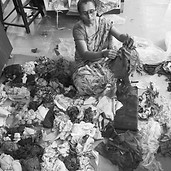
Material Collection & Analysis
Documenting, categorizing, and studying the properties of textile industry (Ganga fashions) scrap.

Material Explorations
Exploring different techniques to understand how chindi can be transformed into new material systems.
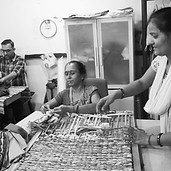
Technique Development & production
Refining material explorations into repeatable techniques and translating them into functional, manufacturable product systems.

Final Collection
Developing a series of contemporary lifestyle products that showcase the potential of textile waste transformation through craft, material innovation, and design.
Design Challenge
Long fabric strips often remain underutilized despite their structural potential. The challenge was to develop durable woven surfaces using irregular textile waste while exploring diverse weave structures that could influence texture, strength, flexibility, and visual expression.
Material Understanding
Waste strips were selected from the "long strip" category identified during waste mapping.
Material Characteristics:
-
Long, continuous fabric strips
-
Predominantly cotton and cotton-satin fabrics
-
Soft yet durable construction
-
Variety of colors generated from production leftovers
-
Suitable for interlacing and handweaving techniques

Explorations
To understand the potential of long textile offcuts, a series of weaving experiments were conducted. Different weave structures were explored to evaluate their impact on texture, durability, flexibility, and visual composition, helping identify suitable applications for product development.


Final chosen techniques
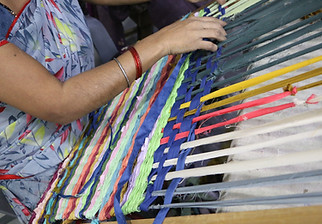
Plain weave with fabric as warp and weft
Manipulated weaving with criss cross technique giving strength, thickness and stability to the surface.
Split ply braiding technique exploring the possibility to showcase scraps as wall decor


Sampling & Training Karigars



Final Collection
Product Range
-
Rug
-
Table runner
-
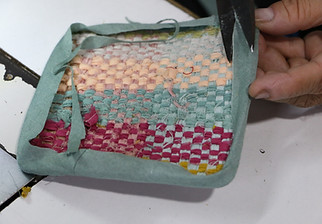
Coasters
-
Wall hangings


Dimensions: 2x5'
Table runner
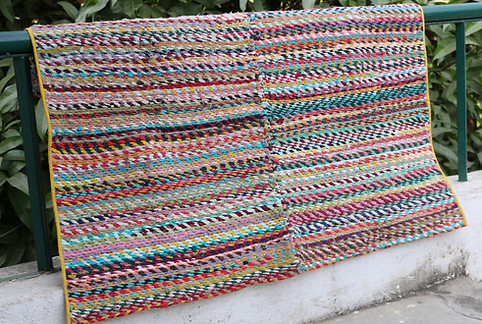
Dimensions: 4x5'
Rug

Dimensions: 4x4"
Cup coasters

Dimensions: 12x12"
Coasters

Wall hangings
